





Sahakarini was established as a charity in 1979 by six Camrosians: Gordon and Mina Schieck, Norman and Eloise Umbach, and Jane and Jack Ross. Over the years we have partnered with organizations on projects in Kenya, Tanzania, Nepal, India, Sierra Leone, Uganda, Zimbabwe, Zambia, Brazil, Haiti, and Guatemala. To understand the heart of Sahakarini and to learn more, read the story of our founder’s sandals below:

Gordon Schieck (left) passes sandals to Sahakarini Past President Alan Fielding
A Simple Pair of Sandals
An old, worn pair of sandals with a lot of history. The story begins with an artisan in India in the 1950s, who made a sturdy pair of sandals and sold them to Gordon Schieck. Gordon and his wife, Mina, spent about 10 years as missionaries in India and Gordon walked to many communities in those sandals. Gordon and Mina saw that the people’s needs were great, but they could, with some help, learn to help themselves. Fast forward 40 years Sahakarini has been formed and has sponsored dozens of projects in India, Africa, South America, and the Caribbean. Matching funding from the Alberta and Canadian governments has multiplies the impact of our projects in health, education, skill training and community development.
At the first Sahakarini Loaves and Fishes Dinner in 2001, Gordon’s sandals were spirited away (with Mina’s help) and were auctioned off and then President Alan Fielding was lucky enough to be the highest bidder. He wanted to “walk a mile in his sandals”. In March 2002 Alan took them to Brazil where he visited two Sahakarini-sponsored projects, a daycare centre under construction and a trade school beginning to offer programs. The dust of the streets of Sao Paulo (population 25,000,000) mingled with the dust of India (population 1.1billion) and Camrose (population 15,000).
The saga of the sandals continues to the present day. Every year Gordon’s sandals are auctioned at our annual Loaves and Fishes fundraising dinner. The highest bidder keeps the sandals for one year and also obtains a tax receipt for the amount of the winning bid. The successful bidder a few years ago said, “Every time I put them on, I remember Gordon and what we are trying to do through Sahakarini.” This simple pair of sandals has been far and near and their journey isn’t over. The sandals continue to be a popular auction item at our annual fundraiser, the Loaves and Fishes dinner.
“When I wear them, I think of the original owner, Gordon Schieck, and the good work he did over the years. His example is certainly a strong one for me,” says Alan Fielding. “It’s always fun to see them go to another person and see them walk a mile in Gordon’t sandals.”
Gordon’s sandals are a symbol of Sahakarini’s commitment to helping the vulnerable and marginalized. They are made to go where there is need and where there is love.
For more on the story of Gordon’s sandals read Gordon’s Travelling Sandals.

Our Approach
Our name, Sahakarini, is a Hindi word that means cooperation. Our name also means working across. This is fitting because Sahakarini works across oceans and continents, and racial, religious, cultural, economic, and social differences both at home and abroad.
Helping the vulnerable and marginalized to help themselves: The first thing we look for is whether the proposed project complies with our Mission Statement: “To help the vulnerable and marginalized to help themselves”. Our goal is to involve, empower and enable people in practical ways at the grassroots level.
Strong and committed project partners: Then we look for a strong and committed project partner in the receiving country. Sahakarini does not have field staff. We work with partners in the receiving country whom we know and trust. It is essential that our project partner show excellent accountability and communication skills. No one likes to see money wasted, or have projects lose direction. We require that our partners report regularly and completely.

Across differences: Next we examine the proposal to see if it is a project which benefits all disadvantaged members of the community, regardless of colour, ethnic origin, class or creed.
Basic needs: We have found that projects which promote education and health care, and clean water have been the most successful.
Women and youth: Women often face discrimination and injustice at many levels. Our projects aim particularly to address these injustices and provide opportunities for women to gain literacy, trade skills and primary health care as well as have their voices heard.
Environmental awareness: All projects must take into account their immediate and longterm environmental impact. Recent work on wasteland reclamation for farming in India has been a highly successful example of economic development that is environmentally sustainable.
 Women Weaving
Economic development for sustainable futures: Practical vocational training for women and men provides a way out of poverty for families, improved status for women, and greater opportunities for children. Micro-credit facilitation is sometimes part of the program. For long term growth and greater income levels, loans to individuals and groups for viable businesses are preferable to grants. (The Grameen Bank in Bangladesh is an outstanding example of the benefits of micro-credit. Its founder, Mohammad Yunus, and the Grameen Bank recently received the Nobel Prize – not for Economics, but for Peace.)
Sustainability: In the event that a project or elements of it are intended to continue longterm there must be a plan for how it will become self-sustaining. Because of our focus on long term development and sustainability, Sahakarini does not get involved in disaster relief unless our project partner or project area is directly involved and a designated donation is made.
How Does Sahakarini Choose a Project?
[c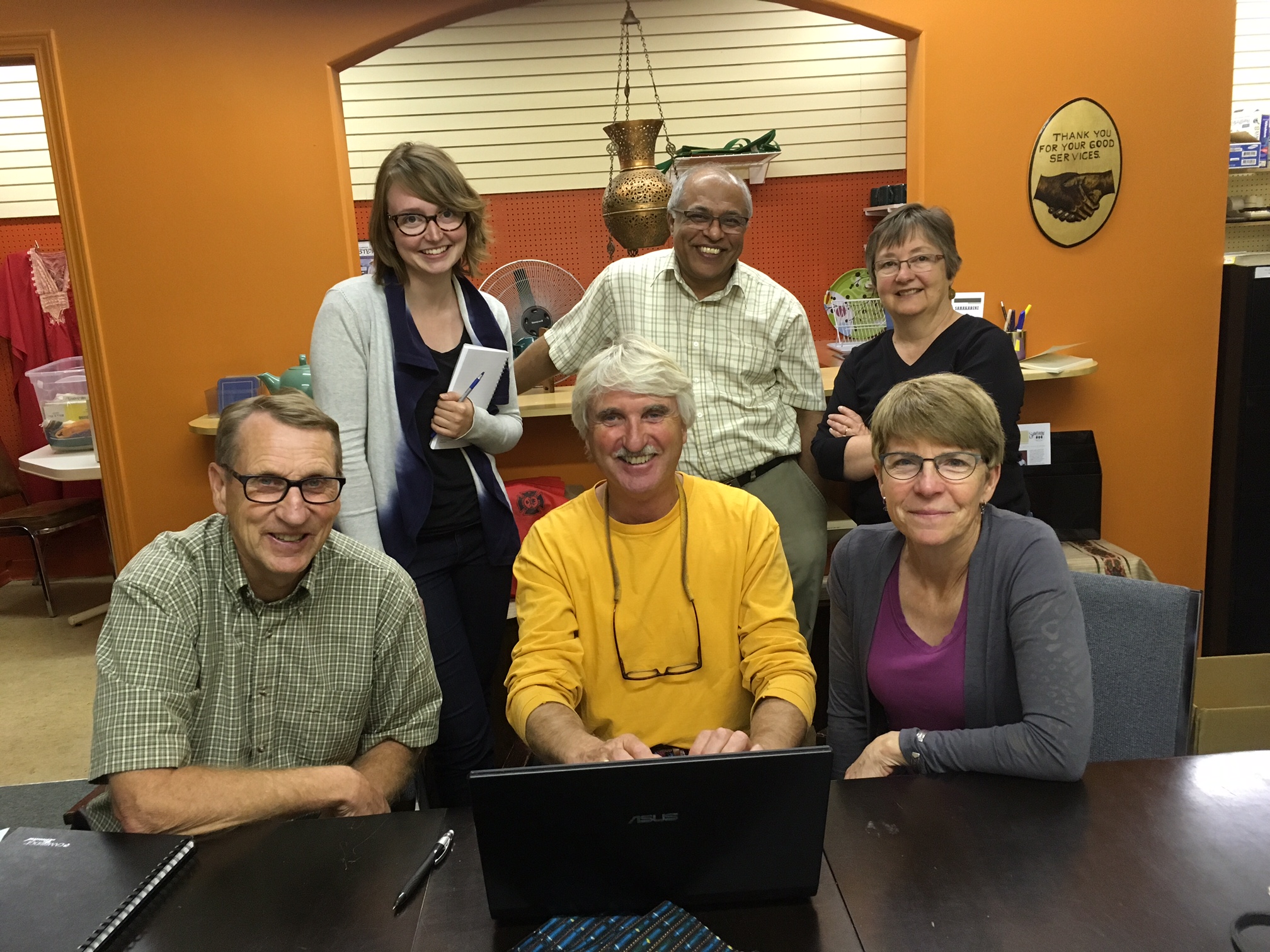 Projects Committee
We receive project requests from all over the world. We cannot possibly respond to all requests for assistance so we have developed some criteria to help us decide which projects to support. The first thing we look for is whether the proposed project complies with our Mission Statement: “To help the vulnerable and marginalized to help themselves.”
Secondly we look for a strong and committed project partner. Typically, Sahakarini like to enter into projects with persons and organizations which are personally known to us to be committed, trustworthy and competent. this is critical to a successful project.
Next we examine the proposal to see if it is a project which benefits all disadvantaged members of the community, regardless of colour, ethnic origin, class or creed. All members of the community are entitled to share in the benefit of our projects.
We have found that projects which promote education and health care, particularly that of disadvantaged women, have been the most successful. Many women in developing countries are disadvantaged in terms of education and health care available to them. Improvements in literacy, trade skills and primary health care, particularly of women, bring a tremendous benefit to the whole community and offer a way for its members to escape endemic poverty and disease. For long term growth and greater income levels, loans to individuals and groups for viable businesses are preferable to grants. The Grameen Bank in Bangladesh is an outstanding example of the benefits of micro-credit. Its founder, Mohammed Younus, and the Grameen Bank, recently received the Nobel Prize – not for Economics, but for Peace.
Next, we assess a project’s sustainability. To be successful, a project must become self-supporting within a reasonable time. We see our role as “jump starting” worthy projects, which will then be able to continue on their own. Of course, health care and education projects may have difficulty in becoming self-sustaining, but if the project is successful and wanted by the community, a way can usually be found to see that it is continued. This may occur by it being taken over by a municipality or some other level of government, or by developing income generation or a fee structure.
Does the potential project partner show excellent accountability and communication skills? No one likes to see money wasted, or to have projects lose direction. In addition, funders such as the Canadian International Development Agency or the Wild Rose Foundation, require that we report regularly and completely as to the use and results of their funding support. Complete honesty and prompt and complete reporting are a must. They also add to Sahakarini’s credibility with our donors and funding organizations. Fax and electronic communication make it much easier to communicate than in the past, but reports don’t write themselves! If our prospective project partner is unable to provide full, prompt and effective reports, we will not proceed with a project.
Projects are the life-blood of Sahakarini and are typically funded for a 1-3 year duration. The above criteria help to ensure our scarce resources are committed to projects that are effective and fulfill our mandate.
Sahakarini Supports Community Service Learning
Sahakarini and the Learning and Beyond Lab at Augustana Campus of the University of Alberta are collaborating in a mutually beneficial program called Community Service Learning (CSL). CSL students are able to develop cooperation and communication skills that expand their learning through applying their research and skills to practical projects in the Camrose community.
Sahakarini CSL student volunteers have helped with the Loaves and Fishes Fundraising dinners, creating displays and bringing their youthful enthusiasm to our event. They have inspired and encouraged the Sahakarini Board to participate in social media to include a wider audience in our caring and active relationships with global partners. Students have provided a marketing plan with helpful suggestions for making Sahakarini more visible at the University and in the wider community. CSL students have participated in board meetings and on committees. They have provided reports on our projects and on our organization based on their research.
This fruitful relationship between Sahakarini and the CSL students matures and expands perspectives of both parties, and enriches understanding and decision making through our inter-generational connection.